Showing posts with label disney. Show all posts

Tuesday, January 22, 2019

Expedition Isles: The Old Stomping "Grounds"


At long last, we're off!

          Welcome to the second installment of my series of essays in which I charge brazenly onward toward my goal of creating a new theme park. The first blog entry can be found here. This time around, we're going to be discussing the park's entry land - SOCIETY GROUNDS. 

          In my last post, I delved into the various type of park entrances, what makes them work, and how they benefit the park as a whole. Here, I will be applying that analysis and the lessons learned to try and make a first land that not only stands well on its own, but also surmises the themes and motifs guests should know going into the park. So let's get started!


The Story


          Society Grounds serves as the headquarters and transportation hub for members of the Global exPloration Society, or G.P.S. This multiracial, multicultural campus is positively buzzing with activity, as explorers present their latest findings to a rapt audience, newsies shout out the latest  discoveries that have come in hot off the presses, and the music of an age gone by drifts down from open windows. While the architecture takes inspiration largely from Europe, it's hard to place exactly where these grounds might actually be located. Guests are welcomed into the land as the latest Society recruits, out to make a name for themselves as famous explorers and treasure hunters - this is a role guests will play to varying degrees for the entirety of their park experience. Guests will shape their own story as they go forth, but there are certain storylines set in place for them to follow, several of which begin in Society Grounds: 

  • Cartography Challenge - Because I'm not calling it MapQuest! Guests will check-in at the Royal Hall of Geography to begin their quest to map the entire park. Here, guests will be given pieces of the map G.P.S. has managed to gather (Society Grounds and one more land chosen at random), and must visit other lands to find the other pieces of the map. Finding all pieces will reward guests with not only a completed map, but also grant access to the second floor of the Royal Hall, where they might enjoy tea and listen as cartographers past regale them with stories of distant lands. 
  • Mysteries of the Museum - The things found in the G.P.S. Museum of Mysteries could never really exist...could they? Bring back photographic evidence for the curators and you may be rewarded! (Guests will be rewarded with a commemorative pin with the G.P.S. motto).  
  • Field Research - Explorers looking to further their knowledge of the world around them are looking for assistants! Guests may answer trivia about the park or real-world history to earn gold coins - 5 of which can be traded in at the Bazaar for a small trinket. (Sample question: What do the flags about The Galley mean?)
  • Harkhuf Brigade - A splinter faction of the G.P.S. who explore only for profit, and care not for knowledge. The seeds of this storyline are subtly placed in this land, and its not really a quest so much as something that guests need to figure out on their own. The Brigade's nefarious goals play into several attractions and a nighttime show. Brigade members are also included around the park disguised as ordinary G.P.S. members (think SHIELD/Hydra, but with cast members) and discovering their identity may lead to amusing interactions or minor rewards. (Fun fact: The name Harkhuf is taken from an early Egyptian explorer who's expedition was entirely focused on trade. He's not evil though, and is actually just a really interesting historical figure!)


The Setting


It wouldn't be any fun if I just told you what the Society Grounds is like without showing you, so let's explore the setting together! A disclaimer: all art below is mine unless stated otherwise, and though I have tried to visualize my ideas as best I can, I am not a professional artist. Just a heads up! Regardless, I hope that the ideas behind the art come through clearly, but if not I'll be happy to answer any questions you may have!

We'll start with an overview (click to enhance): 


This diagram shows the general layout of the land from a bird's eye view. Please note that everything is roughly to scale. By looking at the points of interest, you can gain a sense of the land's flow, but I'll go a bit more into their individual stories below. 

  • G.P.S. Museum of Mystery - The park's entrance building, similar to Disneyland's train station. Rather than a waiting area, the second floor houses a museum dedicated to the mythological and items of a mystical nature. Sort of like a more serious and period version of Gravity Falls' Mystery Shack. Of course, the current curators are dismissive of such outlandish poppycock, though younger staff seem to believe. (This is part of a generation gap that can be noted around the land). 
  • The Royal Hall of Geography - A deliberate homage to the Royal Geographical Society, this building serves as the City Hall/Guest Relations of the land and park, and is also the hub for the Cartographer's Challenge. Records of the society's history are kept here as well. The entire building is not featured in the concept art below, but it would look something like this: 
Fun Fact: The official name of the building is Lowther Lodge. 
  • Bizarre Bazaar - A shop set up for expedition and general goods by some younger explorers looking to retire early. Aside from their inability to spell, the shopkeepers are good folks who have some real bargains. All merchandise here - and within the rest of the park - is themed appropriately (though things like umbrellas are still available). Guests looking for non-themed merchandise will have to find it in a gift shop outside the park. 
  • Society Station - The Society Grounds' train station greets trains ready to take you further into the park. While they do provide transportation, the train ride here will be a full-themed ride taking loose inspiration from Murder on the Orient Express. Trains themselves will be designed to replicate the luxurious passenger liners of the early 20th century, including some variance in train car design. I'll be making posts about individual attractions later and I'll go into more detail then. 
  • Adventure Tower - A clock tower with a lookout post on the roof that provides grand vistas of the park. Guests can gain access to this tower from it's south side. 
  • Fount of Knowledge - A fountain featuring a globe at it's apex and celebrating the pursuit of knowledge around the world. Some of the older explorers here refer to it as the Fountain of Youth, on account of the fact that travel keeps them feeling young. A photo spot and rest area. 
  • Around the World in 80 Days Ride - A ride loosely based on Jules Verne's classic novel. Guests will board balloons and travel from the Society Grounds to a bustling city, seeing some of the grandest sights the world has to offer along the way. If the show building looks a bit small, it's because the building actually extends into the next land over, but the onstage part in Society Grounds does not. This ride will have two separate tracks and two separate experiences - one leaving from Society Grounds heading into the city area, and one leaving from the city area returning to society grounds. Like with the trains, I'll be making a longer post going into more detail about this one. 
    • Phileas Fogg Meeting Spot - A balloon parked next to the ride entrance is the meeting area for Mr. Fogg, the protagonist of the novel. A bit older, wiser, and now brimming with good stories, Fogg will make appearances here throughout the day. Any time he is not present, the balloon will be open as a photo spot. Fogg will look something like this: 

Charming, no?

  • The Galley - A restaurant and snack area, The Galley is run by a former G.P.S. sea cook by the name of John Gully (Making it Gully's Galley, really). Since settling on dry land, Gully has added some non-seafood items to his repertoire, though seafood is still his specialty. While most find his food to be top-notch, some detractors have hung sailing flags outside the entrance that basically translate to "Danger! Steer clear!" The interior is decorated to celebrate the maritime explorers of the past, and there's a group that comes around singing traditional sea shanties every couple hours. 
  • Box Corridor Restrooms and Lockers - This one is pretty straight forward, but the corridor to get to the restrooms and lockers is one straight out of Indiana Jones, with boxes and crates piled high from past expeditions. There's an Ark of the Covenant Easter egg, but this isn't some warehouse - this is the shipping and receiving area for the Grounds, or where all of the artifacts from recent expeditions are located until a more suitable home for them is found. All the same, some crates have been here a very long time. Take a look!: 


          With the general overview of the area out of the way, let's move into the visualization of these areas. Upon entering the park, you'll find yourself in the gardens of the Society Grounds, which take the shape of a dense rainforest. Columns from all sorts of past civilization can be seen buried deep in this jungle. The jungle paths lead up to a singular building - the Museum of Mystery, through which guests enter to the rest of the Grounds. The park entrance will look something like this: 


           A few more details to point out here - between the two entrances lies a fountain, taking the form of a waterfall split by an arm thrusting a torch forward. The arm and torch are stone, but the flame is real. Above this, the G.P.S. motto in Latin appears. It reads: Semper et deinceps, Stulta tamen intrepidus, or in English - "Always forward, foolish yet fearless." (My Latin is courtesy of an online translator, so if anyone knows a more accurate translation, please let me know!) The fountain tries to embody that sentiment. This first area is meant to be a transitory space in which the guests willingly enter, subconsciously putting them in the mindset of an explorer before they have entered the park proper. The varying origins of the presented columns and flora also try to make this space a coming together of cultures, reflecting guests' various places of origins and hopefully preparing them for the experience ahead. Finally, the design of the Museum of Mystery building is largely taken from Oxford's Museum of Natural History:


           I tried to keep the Museum of Mystery similar enough to maintain the museum motif, but I also wanted to try to add a temple-like quality of reverence to it, as the entrance plaza is intended to be a place of peace and reflection. 

Moving through the building, we come to the main thoroughfare of the Society Grounds:


          Here we see the facades of the buildings listed in the land layout diagram, and the general thrust of the walking areas. The facades are given a warm, generally reddish hue to signify how warm and inviting this land is, though the splashes of deep red hint at the danger that lurks outside the Grounds. In general, the grounds should feel familiar, both in terms of guests' own lives (much like how Main Street evokes a sense of home), but also meta-textually. The land plays off guest expectations for a theme park, and is overall fairly traditional. There's a dark ride, a train, a gift shop, and a weenie. All the essentials are there to make the guest feel at ease. Other lands will play this meta-relationship a bit differently, if everything goes according to plan. 

          Items of interest in this concept include the corner of the Royal Hall of Geography, the canvas banners marking the bazaar, and the cardinal-direction clock faces on Adventure Tower, as well as the crow's nest lookout point. Other notable items - the entrance to the Around the World in 80 Days ride is a building with a sign reading "Fogg's Landing", and the design of the building is taken from a early 20th century rail station, mirroring the actual train station on the far side. The balloon's color scheme is taken from the covers of several reprinted editions of the novel, as well as the 1956 film.

          The sailing flags were noted for their humorous warning above, but they also serve a dual purpose, as do many of the elements depicted here. The crow's nest, the balloon, the flags, the luggage, and more are intended to give guest's a feeling of a land on the move. The Society Grounds are constantly in motion, with people moving in and out and heading to new lands frequently. Though this land is a base for much of what guests can do, this design is intended to keep them from staying too long and remind them that there is so much else to see within the park. It's a base of operations for guests, but not necessarily the main focus of their visit. Indeed, in this concept we can see city buildings and mountains in the distance, hinting that there are plenty more places to explore. 

And, of course, there's the airship.

In my design, Expedition Isles has a closed curtain-style entrance and a hub-and-spoke style park layout. At it's center lies Expedition Plaza, and anchored smack dab in the middle is our park icon - the Spirit of Adventure! 


A very early version of the concept, but hopefully it gives you a pretty good idea of what I'm going for.  

           While Expedition Plaza isn't technically part of the Society Grounds, as the hub is it's own area, the Spirit of Adventure has a presence over the Grounds that can't be ignored. Unlike Cinderella Castle's juxtaposition with Main Street in Magic Kingdom, the Spirit of Adventure is a fulfillment of what Society Grounds has to offer, and should not look out of place sitting at the end of the land. Instead, it continues the transportation motif established in the Grounds, and serves as a gateway both literally and metaphorically into the unknown - or at least the other lands of the park. 

          General plans for the Spirit of Adventure include a restaurant in the rafters, complete with splendid views and vintage news reels and serials projected on the interior walls, and a walk through Explorer Hall of Fame in the passenger area. This Hall of Fame would pay tribute to real explorers throughout history with a focus on the courageous men and women of the late 19th and early 20th century. While Expedition Plaza in this rendering is designed to look like a large compass, I have relegated that role to Adventure Tower and the plaza will instead have a large world map motif. Occasionally, when someone walks on certain points, a red line will follow them to their next destination on the motif, a la the classic transitions of Raiders of the Lost Ark. 


          And that's a wrap for just about everything Society Grounds has to offer! It's an entrance land that sets up our guests as explorers, invites them to participate in the fun, and gets them ready to get going to see what the rest of the park has to offer. It does all of this while providing some history to the land and park as a whole. Or, at least, I hope it does! 

So what do you think? Does the land stand on it's own well enough? Is there anything you would add or remove? Let me know in the comments! 

Oh, and thanks for reading!


Wednesday, August 8, 2018

Explorers Adrift on a Troubled S.E.A.


If you've spent much time in the Disney Parks community, you've certainly heard about the Society of Explorers and Adventurers - or S.E.A. for short. What started as a park-wide storyline in Tokyo DisneySea has now spread to nearly every Disney resort, with references and story elements being folded into restaurants, rides, and even water parks. There's been discussion about whether the swell of the S.E.A. is a good thing or not for the parks, but this discussion has masked a different question that needs to be asked:

Is S.E.A. a good organization? 

          I think the presumed answer, by both fans and Disney itself, is yes. Guests generally take things in the park at face value and if something is cool, it's generally considered "good". So too, S.E.A. has been hyped up by Disney as a marketing tool and generally cool group. Looking at the context of S.E.A. and its attractions across the parks, however, I think there's a fair amount of evidence within S.E.A.'s history to suggest that the organization is more murky than it might first appear. Let's see what we can dig up on this fabled adventure society. 


Like all good non-supervillianous organizations, S.E.A. had its humble origins in a fortress at the base of a volcano. 

          First - its ethos. S.E.A., if you trace its history back, was first founded in Renaissance times, and was based on goals of exploring the world through science. The size of the organization in this time period is unknown, though we do know the group was based in a seaside fortress and counted Magellan and Da Vinci amongst its members. Because there's no other attractions focused around this time period, we don't have a whole lot of other information about this period in S.E.A.'s history, (though to speculate, Tokyo's upcoming Soarin' attraction may add something to the lore). We can't even say for sure whether the later 19th and 20th century organization is actually a continuation of the same S.E.A. seen in Fortress Explorations, or if it's a completely new iteration. Nevertheless, everything we do know about this period in S.E.A.'s history suggests they are fairly ideologically pure. 

          If the two organizations are one and the same, then S.E.A.'s purpose has changed a bit in the intervening centuries, as the explorers seem to have given way to the adventurers. This is the period we are more familiar with - the S.E.A. of the pulp adventure era, of characters like Harrison Hightower III and Lord Henry Mystic. It's also the era in which we begin to see some questionable morality. 


          Pictured here is the totality of S.E.A. membership in 1899. Eight members who look ready for explorations into the unknown. But beyond their penchant for exploration, what do we really know about these people? As it turns out, we know a few of them quite well. 


          Harrison Hightower III (on the end of the group photo and pictured above) is a wealthy real estate tycoon who also happens to be a world famous explorer. He's also a pretentious fellow, believing himself to be above others, and even further above the natives of the far-flung lands he travels to. He also hoards the treasures he collects in secret storage in his hotel, refusing to share them with the public despite having a large space in which to do so. Eventually his ego is his undoing at the hands of a cursed idol. A prominent member of S.E.A.? Certainly! A great human being? Not so much. 


          The fine fellow is none other than Lord Henry Mystic, here accompanied by mischievous monkey companion Albert. Like Harrison Hightower, he's a ranking member of S.E.A. with a penchant for collecting rare antiquities. Unlike Harry, he's a bit more benevolent, opening up his house for tours of his collection. More evidence of his kindly disposition: his rescue and adoption of Albert the Monkey. For all his kindness, though, Lord Henry is a bit foolish. Often he stumbles close to great discoveries before his monkey Albert actually discovers them. While Henry doesn't totally buy into the supernatural, he is a bit more respectful of it, taking care not to touch dangerous magical artifacts. Still, leaving cursed objects lying around endangers his guests (read: us) with him none the wiser. That's at least a little irresponsible. 


          Finally, we come to the lone lady of the bunch: Mary Oceaneer. Though a sea (S.E.A.?) captain by trade, she's more of an old-fashioned treasure hunter at heart. Not only does she have pet parrots, but she also occasionally hosts "pirate nights" onboard her vessel. Mary possesses an ability to roll with whatever situation befalls her, and she's also the only known member of S.E.A. to use a laboratory on her adventures. Ironically (given her piratical tendencies), if anyone embodies the original S.E.A. ethos in this group, it's Mary Oceaneer. 

          Between these three characters, we see that S.E.A. members can range from egotistical to a fault, to benevolent yet irresponsible, to idealistic and adventurous. Make no mistake - as characters the members of S.E.A. are well fleshed out and interesting, especially so for theme park characters. But what exactly do they tell us about S.E.A. as a whole?

          Looking at the commonalities of this membership, we can derive a few truths. First, the original S.E.A. ethos of scientific exploration has mostly been abandoned in favor of the pursuit of riches. While some members, such as Captain Oceaneer, still give some weight to science, other members have appeared to turn towards myth. In actuality, the members of S.E.A. don't really seem to take even myth seriously. One member has met a fate worse than death, while another has recklessly endangered his guests thanks to blatant disregard of his own discovery. Members are certainly interested in acquiring rare artifacts, but there seems a curious lack of interest in actually understanding them. When you look at their experiences, it makes a certain sort of sense. The members of S.E.A. are rich, they've traveled, and they think they've seen everything. Why should anything be able to touch them?*

          Of course, we know better, though it is doubtful the members would actually listen to us. With such a small membership consisting of some few wealthy elite, S.E.A. is exclusionary. Consider this: though there are a wide variety of S.E.A. attractions throughout Disney parks, none of them place us in the role of S.E.A. members. In most we are simply visitors who have been allowed into spaces we normally would never get to see through some fluke or stroke of luck. While Mary Oceaneer is perhaps the most welcoming and willing to host us in various settings, it is also an interesting subtext that she is the only woman in the group. The others? Much more of an old boys' club. Were the proprietors of Skipper Canteen not so obsessed with stealing a fast buck, we would never have seen the group's secret boardroom tucked away in the back. 

          I think much of this boys' club/secret society vibe is intentional, and is actually used to great effect in shaping atmosphere across the S.E.A. attractions. These are places we aren't meant to be, which adds something to their mystique. It's good themed design, and a great way to flesh out adventure-themed areas by covering tropes the lands originally never touched. But is it good that a society that thinks it knows what's best for the world's antiquities (but clearly doesn't) isn't open to new members (us) or new ideas?

          Later in the S.E.A. storyline, more members are admitted, including Jock Lindsay - Indiana Jones' friend  and pilot, who is overcome when he finds the very touristy "Fountain of Youth". The organization's inclusion of members like him, as well as collaboration with the owners of the dubiously credentialed Jungle Cruise in S.E.A.'s later years have led some on here to suggest S.E.A. declines fairly early in the 20th century, and I'm inclined to agree. However, I believe the decline starts here - in S.E.A.'s "Golden Age" - when ideology is pushed aside for the cultural and fiscal enrichment of various members. By failing to adhere to S.E.A.'s founding principles - of disciple, curiosity, and inclusion - the 1899 Society of Explorers and Adventurers has already begun to falter. 

          I cannot help but wonder if Disney is prescient to the implications of this storyline. I sense they know that S.E.A. as a society is flawed, and I actually think that's great for telling stories. S.E.A.'s existence in a morally grey area allows for much more interesting subtext in attractions, as well as some small degree of historical accuracy, if not to the actual time period then to the pulp era of serial fiction. S.E.A. is an exploration of pulp adventure in virtually every way, and to ignore the themes and conflicts of its source fiction would leave it naught but a hollow tribute . 

          Still, if this narrative holds true, S.E.A. does have one major issue that goes beyond the story: it's exclusion of guests from the society. We may visit S.E.A. buildings and characters, but we are forever locked into an outsider's perspective when it comes to their stories. Of course, if S.E.A. is not quite a purely good organization, perhaps it's better to not let your guests join in, lest you lump them in with S.E.A.'s issues. Still, an outsider's perspective has limits, especially when you're cutting off people from truly becoming an "Explorer/Adventurer" in a park where dreams are supposed to come true. 


          I sense the Imagineers understand this issue, which is why they've already taken steps to address it by creating a new society that is everything S.E.A. is not: the League of Adventurers. Located in Adventure Isle in Shanghai Disneyland, the League is one of the driving forces of the entire land. The League is inclusive - not only featuring a diverse membership from around the world, but also recruiting all guests - both Chinese and international -  as members on the quest to find the source of Roaring Mountain's namesake and explore the Isle. What's more, none of the members are eccentric millionaires. Most are specialized scientists with a healthy smattering of cultural researchers mixed in. Speaking of cultural research, the League's scientists study the Arbori - the tribal people of the land, but never deride or condescend to them, instead choosing to work in collaboration (a sharp contrast to the disdain of Hightower or the clumsiness of Mystic). If S.E.A. represents an age of exploration past, then the League** represents its future. All this despite the two organizations being largely contemporaries of each other. 

          I bring up the League of Adventurers not to disparage S.E.A., but to point out that S.E.A.'s design is both largely intentional and largely recognized. All too often in Disney theme parks the past is idealized to an extreme degree. After all, Disney prides itself on being an escape from the real world. Main Street is devoid of any racial or economic tensions from the time, and Frontierland takes no issue with Manifest Destiny. One could easily chalk this difference in design ethos to a generational gap, but even newer iterations on the formula - Animal Kingdom's Asia and Africa for instance - still view the past and even present with rose-tinted glasses - removal of the poaching references in Kilimanjaro and complete omission of political and social strife in Asia are but a few examples. 


Kali River Rapids has this logging segment, but its promptly forgotten as soon as you get soaked.  

          But the S.E.A. storyline is different. With this through-line, Disney is working on creating a themed past that isn't necessarily rosy or quite as idealized, one where not everything is black and white. This is a narrative that actively portrays certain S.E.A. members as immoral, yet still features them as protagonists. Cultural issues, bigotry and elitism not only exist, but are acknowledged. What's more, by allowing guests to see S.E.A. in different time periods, we're also able to understand that these issues have consequences in the fictional world, just as they do in the real one. This is theming that goes beyond simple facades or a basic ride storyline, and it's very ambitious to say the least. It's not quite a Westworld park storyline that will redefine your whole conception of reality, but its certainly enough to start guests thinking about the problems of the past and how they might affect the world today. And its certainly more thought-provoking than most modern park additions. 

          S.E.A. is intentionally flawed an an organization, yes, but it is generally strong themed design, and as such gets to ask much more interesting questions than theme parks traditionally ask. For that reason, I'm excited to see where the story goes from here, though I'm even more excited for the possibilities this story structure could allow with other, original plot lines. Could we get a more developed storyline in Frontierland? How about some interesting setup for Tomorrowland? Should Disney ever turn back to less-IP driven content, such ideas could become a possibility, and they have a strong model from which to work. 

          Though S.E.A. is clearly an experiment and has had its share of failure, it still possesses some wonderful attributes. The storyline itself instills a belief that wonders exist in world beyond our wildest dreams, that adventure lurks around even the most unlikely of corners. So too, it inspires the potential for stronger, more immersive themed environments that challenge guests. It's ambitious, vast, and deep. But then, what did you expect? It's the S.E.A., and I couldn't think of a better place to embark for grander adventures then we've yet known. 

*In case you may not think this theme is intentional, the motif of hubris within the organization is reinforced with the tale of Big Thunder Mountain's S.E.A. members. Member Jason Chandler writes to member Barnabas T. Bullion, warning him of going too far and risking Big Thunder's wrath. Bullion, a member in the mold of Hightower, fails to listen. 

**Interestingly, the two organizations have not officially interacted as of yet, with Adventure Isle only indirectly referencing S.E.A. thru a brief mention of Tokyo's Indiana Jones Adventure. As for what the future holds, I can't be certain, though I suspect S.E.A. will continue to spread while the League will stay in its small pocket of the Disney universe. 

Title Photo Credit


Monday, July 9, 2018

A Tale of Two Towers: The Taller We Stand, The Nearer The Stars


          "Anyone who visits American Waterfront will soon find their gaze irresistibly drawn to the unique form of the lofty Hotel Hightower. The building's unusual design and extraordinary proportions were symbols of the wealth and power of its notorious creator, antiquities collector Harrison Hightower III, and indeed the stories of the man and the hotel are inextricably linked..."

                                                                 -  Press Release, 2006

          Harrison Hightower III is a bad man. From the moment we lay eyes on the Tokyo version of the Tower of Terror from the streets of American Waterfront, we know this to be true. The twisted Gothic monstrosity that is the Hightower Hotel just oozes an evil aura from its towers and spires. Yet not a word has been said to us. We haven't even entered the queue yet, and the Tokyo Tower is already wielding its greatest weapon: visual storytelling.  

          While visual storytelling is used in the other Towers, often to create little vignettes that contribute to ambiance, in Tokyo it is in full force, blending experiential and narrative storytelling into one powerful narrative centered around one man: Harrison Hightower III. In doing so, the visuals here give the Tokyo Tower something the others lack - a focal point. No matter where we are in this attraction, Harrison Hightower is always in focus, and as such, the story of the Tokyo Tower deepens considerably. The tale of the man and the tale of the tower are - as noted above - inextricably linked.


           The story is so vast, in fact, that it begins outside the queue. Here newspapers are posted describing the last expedition of ol' Harry in 1899 and the dark nature of his adventures along the Congo River - alluding to, among other things, Joseph Conrad's Heart of Darkness. In some other papers not pictured, we also learn about the efforts of the New York Preservation Society (NYPS) to both offer tours of the building and solve the mystery of Hightower's disappearance. Please note that these newspapers tell us very little overall, but are enough to start two distinct stories - Hightower's story, and ours. We don't learn a whole lot about Hightower here except that he was rich and adventurous (his face is a tad too obscured to fully see), but we do now have an understanding of our role. We aren't just going to explore the tower because we stumbled upon it randomly - we're guests on a NYPS tour. 

           Once in the queue, we once again find ourselves among the hotel gardens, seeing a few signs that the building has fallen on hard times, such as a statue that is missing some limbs, before entering the lobby and being immediately greeted by this portrait lording over us:

Behold!

          At last we're able to put a face to the name, and even though the portrait itself doesn't speak, the environment around it does. The portrait is placed high on the mantle, making it so Hightower gazes down upon us, a quizzical look on his face, as if saying "You rabble dare to enter my hotel?" To say this man has an ego is an understatement. His feelings toward himself are etched into the stonework of the hotel outside - The Taller We Stand, The Nearer the Stars. With the Hightower Hotel looming over everything else in the area - nay, the park - Hightower must think himself a god. 

Hightower is the type of guy to get a portrait with an archaeological discovery, turn that discovery into a fireplace in his hotel, then hang that portrait on that fireplace. 


          The build of the fireplace also furthers our own story with its strange and exotic architecture. Even though we are on a tour here, we are also explorers, strangers in a strange land. What is this place, really? A hotel? A museum, perhaps, or a tomb? The utterly bizarre display calls us to investigate our surroundings further and unlock more long dormant secrets. As much as the fireplace is a key story marker, it also establishes a motif of the past - a past that is somehow wrong in a way we can't quite place. On our way through the lobby, we find more evidence of Hightower's eccentricities and failings; magnificent architecture and directories of the hotel showcase the former; the latter is narrated by the murals above. Each work depicts Hightower pillaging priceless artifacts from lands and temples full of danger, though (in a fitting twist) his proud posture makes him blind to the perils behind him. The repetition of these motifs is key, as this is where story and ambiance begin to converge. Below, a few examples of the murals:

While sometimes Hightower upsets the natives...

...he also disturbs idols (note the exaggerated frowns)...

...and - occasionally - even gods. 

          In a way, these depictions of Hightower's heroism are almost funny. There's a pseudo-optimistic bent to his constant daring escapes, and the depiction of each scenario borders on the absurd. In a way, Hightower here nearly embodies an Indiana Jones-esque pulp hero, yet is held back from this status by the destruction left in his wake. Remember, Hightower must have commissioned these paintings, and felt fine with depicting misery occurring as a direct results of his actions. There's a massive disconnect in his brain somewhere if he thinks of himself as a hero rather than merely playing one. 

          We have been given an inordinate amount of information up to this point, though not a word has been spoken. Had we skipped the newspaper outside, we still would understand that Hightower is the very prideful owner of the hotel, and is not afraid to get his hands dirty. We haven't even entered the pre-show area and already have enough information to judge his character. If the audience has missed all of the evidence up to this point, the doors to the pre-show area features an unmissable portrait of Hightower that reiterates much of this information and highlights his obsession with the occult:

Clearly this man's story will have a happy ending. 

          Before we leave the lobby, there's one more item of interest - the mood. Ambiance fills the lobby area with mystery and suspense. We have a setup, but nothing past that yet. The Tokyo Tower has a similar setup to its sister attractions, though in a departure, there is little use of cobwebs or other signs of age. Rather, the hotel is immaculately kept and clean, but the cleanliness paradoxically only adds to its inherent creepiness. The only sight that truly betrays an aura of foreboding is the ruined elevator at the back of the lobby, a sign of things to come. 

          The Hightower plot line has all the elements of a mystery, but we've already been given all the clues we need to determine what happened in the first room alone. Something got back at this man in revenge for his lifetime of looting and sinfulness. In the next rooms, the first official bit of pre-show, these "somethings" will go from lurking in the shadows to the very forefront of the attraction. 

           As we enter the next room, proceeding deeper into the bowels of the hotel, we are greeted by pictures of Hightower's artifacts - some of which we saw previously in the lobby's murals - lining the walls. These photos include some objects in their original locales, but many feature objects being shipped back to Hightower's place of residence. 


          If we are paying attention, these photos should be a warning to us going forward. While paintings naturally place their subjects at least partially in the realm of fiction, photographs are documentation of the real world. By replacing the paintings and murals of the previous room with the photographs of this one, we are being brought closer to danger even as we begin to solve the mysteries of the Hightower Hotel. Unfortunately, we don't have much time to scan the photographs for clues before our NYPS tour guide begins to spiel, recounting Hightower's mysterious disappearance after bringing home his latest discovery - Shiriki Utundu. This is not really new information, but it does keep the link between the tower and the man at the forefront of our minds. 

Moving along...

          We intrude deeper still what must be the heart of the hotel: Hightower's private office. For a man obsessed with his own success, the office is surprisingly low-key. Yes, there are some artifacts scattered around and a stained glass window featuring the man himself, but its nowhere near as glitzy as the hotel lobby. This normality in and of itself is interesting as it adds a sense of realism to both the man and his hotel, but we only get to admire it briefly before our NYPS guide begins to play a phonograph which reveals to us the last recorded words of Harrison Hightower III. A journalist asks him if he believes the Shiriki Utundu idol - which, incidentally, is in this office with us - is cursed, but Hightower dismisses the question with a laugh. 
          
           Suddenly the room goes dark, and the stained glass window changes, creating an image of a terrified Hightower holding the idol. He reveals to us what really happened that night, the way the idol cursed him and his fateful elevator drop of doom. He warns us to beware of Shiriki Utundu, but as we turn to look at the idol in the room with us, he grins and cackles maniacally, before disappearing in a flash. The room returns to normal, but only just. Shiriki is missing, and a secret passage has opened up on the far wall. 


          While a lot of Hightower's plot happens in this room and is fairly easy to interpret, there is much more happening than appears at first glance. In our story, this room is the apex of our investigation, where we finally discover the truth. It is the first supernatural interruption of our tour. More than anything else, however, this office is where the maliciousness of the hotel and its owner is revealed. If Hightower's office is the heart of the hotel - where it lived and breathed and functioned - than Shiriki Utundu is the corruption that has seized it and taken control. 


          It is easy to see Shiriki Utundu as an external force, sweeping in on an unsuspecting man to wreak havoc and corrupt his very soul. It is true that Shiriki is a corruptive force, but it is also true that he is an honest one. As an audience, we aren't terribly surprised when an idol comes to life and curses Hightower because Hightower's selfishness, ego, and corruption have been on display from the moment we first saw his tower in the distance. If anything, Shiriki is the sub-text of the previous rooms made text (please note that Shiriki is literally a background object - like the paintings and photos we have seen thus far - until he comes to life). As a result, his introduction and inclusion feel very natural to the story we are being told, as well as a natural extension of Hightower's character arc. 


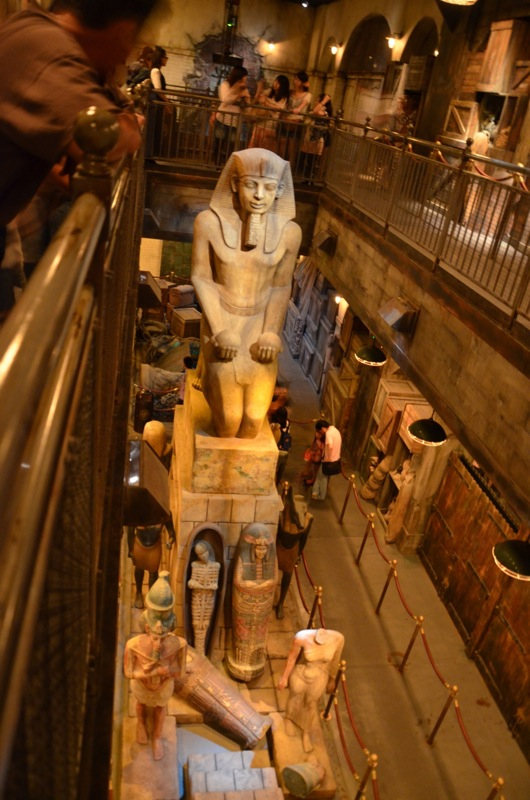
           As we enter the secret passage out of the office, we step into a warehouse-like area of the hotel that seems like it should be off limits to us. If Hightower the man and Hightower the hotel are the same, then this room is nothing more than Hightower's shame, invisible to us until his sins became truly apparent in his office. How many artifacts has he stolen over the years? Crates and cabinets along the walls give the impression that there's more than we could even hope to count. In truth, even one would be too many, for we now know that many if not all of the artifacts Hightower claimed must have been supernatural like Shiriki Utundu, and their removal might have ruined the societies and people they came from. In this light, these ruins of past civilizations and societies are more than just creepy scenery; they're testaments to the megalomania, greed, and immorality of not just Harrison Hightower, but of society at large. For as we scan the rows of crates, we discover that Hightower did not collect his artifacts alone. Real world explorers and adventurers are listed on those crates, and if they're in cahoots with Hightower, then their values deserve some investigating as well. 


Howard Carter: Famous Egyptologist, or man of dubious intentions? (Definitely Famous Egyptologist)
          While it is easy to pass such references off as set dressing, the implication of real historical figures in Hightower's work is important, because it makes it clear that Hightower's failings are not just his - they can be ours as well. This point is driven home by the eyes of Shiriki Utundu - the manifestation of Hightower's inner evil - watching and following us throughout the room. 


He's watching you...
          While Hightower's office was the apex of his story, it is here, in this chamber full of curses and buried secrets, that our own story reaches its climax. Here is where Hightower's story becomes an incredibly human story - our story. Sure, Hightower is a cartoonish caricature of an 1890s robber baron, but his failings are unbearably human. We know that his downfall didn't come from a curse, but from his inner greed and selfishness, his lack of care for other's beliefs and well-being. We have to avoid these traits and learn to be better than him if we are to avoid the same fate. 

         Of course, after any good story's climax, you'll have your falling action. Suffice it to say that the Tokyo Tower of Terror provides this in spades. 


          It may seem odd that both our story and that of Harrison Hightower are nearly complete before we even board the ride itself, but narratively this is actually a wonderful approach, even if it should be used sparingly. By utilizing this approach, the ride portion itself becomes a warning to us. Be better, it says. Stand tall, or meet your (quite literal) downfall. Harrison Hightower's voice-over in the ride portion basically says as much. This isn't some strange warning to not go to the "dark side of Hollywood", but simply to be a better person. There is no blame on the guest for entering the ride, no chastising their decisions. There is instead a look to the future - one that is, paradoxically, somewhat hopeful. The tale of Harrison Hightower could have simply been "The Bigger They Are, The Harder They Fall" (pun intended), and while it is this to some degree, when paired with our own simultaneous story, his becomes an uplifting one. Our story is not that we will inevitably fall prey to our baser instincts, but that we can learn from our past. 


           Consider this: the Tower of Terror's home "land" of American Waterfront is generally set around the 1910s and 1920s. Yet Harrison Hightower's elevator fall of doom was intentionally set on December 31st, 1899. His fall is set not only in our own past, but the past of the land as well - a land, I might add, that is thriving and alive. Harrison Hightower, Shiriki Utundu, and the whole of the Hightower Hotel, with all their ego, greed, and selfishness, are relics of the past. Their story may be "The Bigger They Are, The Harder They Fall", but ours? Our story of leaving their failings in the past and heading out to build a great big beautiful tomorrow? Why it's written right on the building.


Tokyo Tower of Terror Resources

I've investigated the Tokyo Tower of Terror more times than I can count at this point, and there's always something there to draw me back in. If you're interested in learning more, I've written a few smaller articles on my tumblr (see the tab up top). For even more, I recommend the following resources as a starting point.

Dejiki - For a fantastic visual tour of the tower. 

YouTube - Tower of Terror w/ Subtitles 

Theme Park Tourist - Intriguing backstory on the making of the ride

 And as always, feel free to start a discussion in the comments below!


Title Photo Source