Monday, July 9, 2018

A Tale of Two Towers: The Taller We Stand, The Nearer The Stars


          "Anyone who visits American Waterfront will soon find their gaze irresistibly drawn to the unique form of the lofty Hotel Hightower. The building's unusual design and extraordinary proportions were symbols of the wealth and power of its notorious creator, antiquities collector Harrison Hightower III, and indeed the stories of the man and the hotel are inextricably linked..."

                                                                 -  Press Release, 2006

          Harrison Hightower III is a bad man. From the moment we lay eyes on the Tokyo version of the Tower of Terror from the streets of American Waterfront, we know this to be true. The twisted Gothic monstrosity that is the Hightower Hotel just oozes an evil aura from its towers and spires. Yet not a word has been said to us. We haven't even entered the queue yet, and the Tokyo Tower is already wielding its greatest weapon: visual storytelling.  

          While visual storytelling is used in the other Towers, often to create little vignettes that contribute to ambiance, in Tokyo it is in full force, blending experiential and narrative storytelling into one powerful narrative centered around one man: Harrison Hightower III. In doing so, the visuals here give the Tokyo Tower something the others lack - a focal point. No matter where we are in this attraction, Harrison Hightower is always in focus, and as such, the story of the Tokyo Tower deepens considerably. The tale of the man and the tale of the tower are - as noted above - inextricably linked.


           The story is so vast, in fact, that it begins outside the queue. Here newspapers are posted describing the last expedition of ol' Harry in 1899 and the dark nature of his adventures along the Congo River - alluding to, among other things, Joseph Conrad's Heart of Darkness. In some other papers not pictured, we also learn about the efforts of the New York Preservation Society (NYPS) to both offer tours of the building and solve the mystery of Hightower's disappearance. Please note that these newspapers tell us very little overall, but are enough to start two distinct stories - Hightower's story, and ours. We don't learn a whole lot about Hightower here except that he was rich and adventurous (his face is a tad too obscured to fully see), but we do now have an understanding of our role. We aren't just going to explore the tower because we stumbled upon it randomly - we're guests on a NYPS tour. 

           Once in the queue, we once again find ourselves among the hotel gardens, seeing a few signs that the building has fallen on hard times, such as a statue that is missing some limbs, before entering the lobby and being immediately greeted by this portrait lording over us:

Behold!

          At last we're able to put a face to the name, and even though the portrait itself doesn't speak, the environment around it does. The portrait is placed high on the mantle, making it so Hightower gazes down upon us, a quizzical look on his face, as if saying "You rabble dare to enter my hotel?" To say this man has an ego is an understatement. His feelings toward himself are etched into the stonework of the hotel outside - The Taller We Stand, The Nearer the Stars. With the Hightower Hotel looming over everything else in the area - nay, the park - Hightower must think himself a god. 

Hightower is the type of guy to get a portrait with an archaeological discovery, turn that discovery into a fireplace in his hotel, then hang that portrait on that fireplace


          The build of the fireplace also furthers our own story with its strange and exotic architecture. Even though we are on a tour here, we are also explorers, strangers in a strange land. What is this place, really? A hotel? A museum, perhaps, or a tomb? The utterly bizarre display calls us to investigate our surroundings further and unlock more long dormant secrets. As much as the fireplace is a key story marker, it also establishes a motif of the past - a past that is somehow wrong in a way we can't quite place. On our way through the lobby, we find more evidence of Hightower's eccentricities and failings; magnificent architecture and directories of the hotel showcase the former; the latter is narrated by the murals above. Each work depicts Hightower pillaging priceless artifacts from lands and temples full of danger, though (in a fitting twist) his proud posture makes him blind to the perils behind him. The repetition of these motifs is key, as this is where story and ambiance begin to converge. Below, a few examples of the murals:

While sometimes Hightower upsets the natives...

...he also disturbs idols (note the exaggerated frowns)...

...and - occasionally - even gods. 

          In a way, these depictions of Hightower's heroism are almost funny. There's a pseudo-optimistic bent to his constant daring escapes, and the depiction of each scenario borders on the absurd. In a way, Hightower here nearly embodies an Indiana Jones-esque pulp hero, yet is held back from this status by the destruction left in his wake. Remember, Hightower must have commissioned these paintings, and felt fine with depicting misery occurring as a direct results of his actions. There's a massive disconnect in his brain somewhere if he thinks of himself as a hero rather than merely playing one. 

          We have been given an inordinate amount of information up to this point, though not a word has been spoken. Had we skipped the newspaper outside, we still would understand that Hightower is the very prideful owner of the hotel, and is not afraid to get his hands dirty. We haven't even entered the pre-show area and already have enough information to judge his character. If the audience has missed all of the evidence up to this point, the doors to the pre-show area features an unmissable portrait of Hightower that reiterates much of this information and highlights his obsession with the occult:

Clearly this man's story will have a happy ending. 

          Before we leave the lobby, there's one more item of interest - the mood. Ambiance fills the lobby area with mystery and suspense. We have a setup, but nothing past that yet. The Tokyo Tower has a similar setup to its sister attractions, though in a departure, there is little use of cobwebs or other signs of age. Rather, the hotel is immaculately kept and clean, but the cleanliness paradoxically only adds to its inherent creepiness. The only sight that truly betrays an aura of foreboding is the ruined elevator at the back of the lobby, a sign of things to come. 

          The Hightower plot line has all the elements of a mystery, but we've already been given all the clues we need to determine what happened in the first room alone. Something got back at this man in revenge for his lifetime of looting and sinfulness. In the next rooms, the first official bit of pre-show, these "somethings" will go from lurking in the shadows to the very forefront of the attraction. 

           As we enter the next room, proceeding deeper into the bowels of the hotel, we are greeted by pictures of Hightower's artifacts - some of which we saw previously in the lobby's murals - lining the walls. These photos include some objects in their original locales, but many feature objects being shipped back to Hightower's place of residence. 


          If we are paying attention, these photos should be a warning to us going forward. While paintings naturally place their subjects at least partially in the realm of fiction, photographs are documentation of the real world. By replacing the paintings and murals of the previous room with the photographs of this one, we are being brought closer to danger even as we begin to solve the mysteries of the Hightower Hotel. Unfortunately, we don't have much time to scan the photographs for clues before our NYPS tour guide begins to spiel, recounting Hightower's mysterious disappearance after bringing home his latest discovery - Shiriki Utundu. This is not really new information, but it does keep the link between the tower and the man at the forefront of our minds. 

Moving along...

          We intrude deeper still what must be the heart of the hotel: Hightower's private office. For a man obsessed with his own success, the office is surprisingly low-key. Yes, there are some artifacts scattered around and a stained glass window featuring the man himself, but its nowhere near as glitzy as the hotel lobby. This normality in and of itself is interesting as it adds a sense of realism to both the man and his hotel, but we only get to admire it briefly before our NYPS guide begins to play a phonograph which reveals to us the last recorded words of Harrison Hightower III. A journalist asks him if he believes the Shiriki Utundu idol - which, incidentally, is in this office with us - is cursed, but Hightower dismisses the question with a laugh. 
          
           Suddenly the room goes dark, and the stained glass window changes, creating an image of a terrified Hightower holding the idol. He reveals to us what really happened that night, the way the idol cursed him and his fateful elevator drop of doom. He warns us to beware of Shiriki Utundu, but as we turn to look at the idol in the room with us, he grins and cackles maniacally, before disappearing in a flash. The room returns to normal, but only just. Shiriki is missing, and a secret passage has opened up on the far wall. 


          While a lot of Hightower's plot happens in this room and is fairly easy to interpret, there is much more happening than appears at first glance. In our story, this room is the apex of our investigation, where we finally discover the truth. It is the first supernatural interruption of our tour. More than anything else, however, this office is where the maliciousness of the hotel and its owner is revealed. If Hightower's office is the heart of the hotel - where it lived and breathed and functioned - than Shiriki Utundu is the corruption that has seized it and taken control. 


          It is easy to see Shiriki Utundu as an external force, sweeping in on an unsuspecting man to wreak havoc and corrupt his very soul. It is true that Shiriki is a corruptive force, but it is also true that he is an honest one. As an audience, we aren't terribly surprised when an idol comes to life and curses Hightower because Hightower's selfishness, ego, and corruption have been on display from the moment we first saw his tower in the distance. If anything, Shiriki is the sub-text of the previous rooms made text (please note that Shiriki is literally a background object - like the paintings and photos we have seen thus far - until he comes to life). As a result, his introduction and inclusion feel very natural to the story we are being told, as well as a natural extension of Hightower's character arc. 
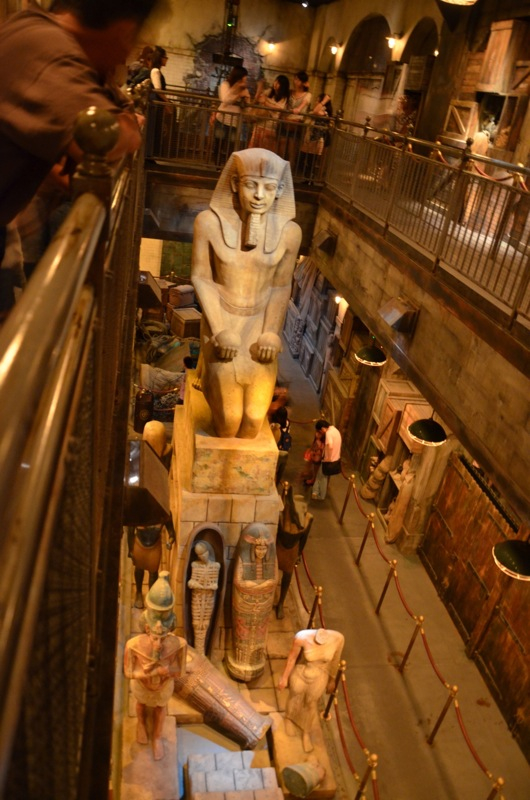


           As we enter the secret passage out of the office, we step into a warehouse-like area of the hotel that seems like it should be off limits to us. If Hightower the man and Hightower the hotel are the same, then this room is nothing more than Hightower's shame, invisible to us until his sins became truly apparent in his office. How many artifacts has he stolen over the years? Crates and cabinets along the walls give the impression that there's more than we could even hope to count. In truth, even one would be too many, for we now know that many if not all of the artifacts Hightower claimed must have been supernatural like Shiriki Utundu, and their removal might have ruined the societies and people they came from. In this light, these ruins of past civilizations and societies are more than just creepy scenery; they're testaments to the megalomania, greed, and immorality of not just Harrison Hightower, but of society at large. For as we scan the rows of crates, we discover that Hightower did not collect his artifacts alone. Real world explorers and adventurers are listed on those crates, and if they're in cahoots with Hightower, then their values deserve some investigating as well. 


Howard Carter: Famous Egyptologist, or man of dubious intentions? (Definitely Famous Egyptologist)
          While it is easy to pass such references off as set dressing, the implication of real historical figures in Hightower's work is important, because it makes it clear that Hightower's failings are not just his - they can be ours as well. This point is driven home by the eyes of Shiriki Utundu - the manifestation of Hightower's inner evil - watching and following us throughout the room. 


He's watching you...
          While Hightower's office was the apex of his story, it is here, in this chamber full of curses and buried secrets, that our own story reaches its climax. Here is where Hightower's story becomes an incredibly human story - our story. Sure, Hightower is a cartoonish caricature of an 1890s robber baron, but his failings are unbearably human. We know that his downfall didn't come from a curse, but from his inner greed and selfishness, his lack of care for other's beliefs and well-being. We have to avoid these traits and learn to be better than him if we are to avoid the same fate. 

         Of course, after any good story's climax, you'll have your falling action. Suffice it to say that the Tokyo Tower of Terror provides this in spades. 


          It may seem odd that both our story and that of Harrison Hightower are nearly complete before we even board the ride itself, but narratively this is actually a wonderful approach, even if it should be used sparingly. By utilizing this approach, the ride portion itself becomes a warning to us. Be better, it says. Stand tall, or meet your (quite literal) downfall. Harrison Hightower's voice-over in the ride portion basically says as much. This isn't some strange warning to not go to the "dark side of Hollywood", but simply to be a better person. There is no blame on the guest for entering the ride, no chastising their decisions. There is instead a look to the future - one that is, paradoxically, somewhat hopeful. The tale of Harrison Hightower could have simply been "The Bigger They Are, The Harder They Fall" (pun intended), and while it is this to some degree, when paired with our own simultaneous story, his becomes an uplifting one. Our story is not that we will inevitably fall prey to our baser instincts, but that we can learn from our past. 


           Consider this: the Tower of Terror's home "land" of American Waterfront is generally set around the 1910s and 1920s. Yet Harrison Hightower's elevator fall of doom was intentionally set on December 31st, 1899. His fall is set not only in our own past, but the past of the land as well - a land, I might add, that is thriving and alive. Harrison Hightower, Shiriki Utundu, and the whole of the Hightower Hotel, with all their ego, greed, and selfishness, are relics of the past. Their story may be "The Bigger They Are, The Harder They Fall", but ours? Our story of leaving their failings in the past and heading out to build a great big beautiful tomorrow? Why it's written right on the building.


Tokyo Tower of Terror Resources

I've investigated the Tokyo Tower of Terror more times than I can count at this point, and there's always something there to draw me back in. If you're interested in learning more, I've written a few smaller articles on my tumblr (see the tab up top). For even more, I recommend the following resources as a starting point.

Dejiki - For a fantastic visual tour of the tower. 

YouTube - Tower of Terror w/ Subtitles 

Theme Park Tourist - Intriguing backstory on the making of the ride

 And as always, feel free to start a discussion in the comments below!


Title Photo Source

Monday, April 16, 2018

A Tale of Two Towers: In The Twilight Zone


          If you believe the hype, Tokyo DisneySea is the best thing since sliced bread, or at the very least since Walt first dedicated the original Disneyland in Anaheim. Chock full of densely detailed environments and original attractions, it is often lauded as the quintessential modern take on the theme park genre. So much of the praise for the park goes to its willingness to take risks and try out new concepts, but I think there is another element at work here that is often overlooked: DisneySea's penchant for taking things that worked well and making them even better. Tokyo's reworked 20,000 Leagues Under the Sea attraction is a prime example of this approach, taking a beloved (now extinct) ride and altering ride systems and show scenes to create an experience that may even outclass the original. A strange creature, this sub ride. 

          Yet it is not the only one, for the Tokyo Tower of Terror is an even stranger creature. While not a unique attraction thanks to its Twilight Zone predecessors, it nevertheless feels like a true original. It lives and breathes in ways that shouldn't be possible for simple stone and mortar. Each segment of the attraction flows seamlessly into the next in ways that the original Twilight Zone Tower cannot. I've thought long and hard, and now finally come to the conclusion that it is Tokyo's Tower of Terror - not the Twilight Zone original - that is the definitive version of the ride. 

          What sets the Tokyo Tower apart from its Twilight Zone-flavored cousins is more than just a matter of different theming. No, what sets this attraction apart are its powerful dual senses of story and ambiance, interwoven so closely that a confluence occurs, transforming the two into one and the same...

          But I'm getting ahead of myself. Let's go back to the beginning. In fact, let's turn it into a tour. Yes...a tour through a haunted hotel sounds like a fabulous idea. After all, what's the worst that could happen?


Thursday, March 29, 2018

"Is Shanghai Disneyland Truly a Disneyland?": Theme and Culture in The Middle Kingdom


Before you say it - I know, the question might seem ridiculous. There's a castle. There's immersive themed lands. There's even a fireworks spectacular starring Mickey Mouse. What are you talking about? Of course Shanghai Disneyland is a Disneyland! It's a castle park built by Disney, after all. You're right, of course. Working for Disney in China has given me countless opportunities to visit the park and I've seen enough there to know it certainly meets Disney-levels of production quality. So too, the park hosts a wealth of wonderful attractions. But still, beneath all those bells and whistles, beneath the glossy veneer and the elaborate sets...

Is it?

            I'm not talking about the attractions or the characters. I'm not even talking about the individual lands. Instead, I want to focus on the underlying principles of the park. In other words, it's themes, the very heart of what makes Shanghai Disneyland tick. First, however, we have to answer another question: what makes Disneyland a Disneyland? What is so compelling about the place to the point that it has virtually transcended its status as a theme park?

            At its core, Disneyland isn't a theme park about Disney. Disneyland is about other things. That might seem confusing, but then Disney as a company has always been about other things. Let's take a look at the first few Disney movies ever made. Snow White, the star of the company's first feature, wasn't invented by Walt - she was cribbed from European folklore and a play Walt saw when he was a child. Pinocchio, likewise, came from a 19th century Italian story, and Bambi was originally a novel. Fantasia based itself on famous music of Walt's time and of ages past. All of these works, then, are derivative - direct adaptations of previous work. This isn't a surprising development. Even prior to its early films, Disney was adapting the work of other studios. After all, Mickey Mouse himself was little more than a derivative of Oswald, a Walt-created character whose rights belonged to Universal Studios.

            Note that by no means is this a criticism. Media companies and artists have always depended on adaptation and reinvention, and Disney is no different. It must find external subjects to present in order to survive. Many people laud Disney for its storytelling, and Disney itself finds great pride in the stories it tells. Rightly so, in most cases. 


In most cases.

         
  Yet I don't think storytelling is the key to the company's success. Rather, it is their definitive authorial voice and presentation of their stories that matters. Let's go back to the stories I mentioned earlier. Snow White is a Germanic fairy tale about a princess who ends up living with seven men while hiding out from a witch. Pinocchio is a morality play about a wooden puppet and his cricket conscience. Bambi is a tale of growing up in the woods and learning what it takes to be a leader. On the surface these stories have nothing in common. No matter how well you tell these stories, there will never be a point where they begin to fully resemble each other. If I asked you to tell me what the commonality in all of these tales was based on narratives alone, it wouldn't quite be impossible, but it would be at the very least quite difficult. These stories don't inherently belong together, yet we think of them all as belonging to  one group. Why? Because they're all Disney cartoons. The commonality is in the presentation, not the narrative.

           Since its earliest days, Disney has brought a diverse array of film subjects and stories into its canon, and it has done so by developing a signature tone. Usually, the company approaches these topics with a certain naïveté and often a reassurance that everything will be alright in the end. This thematic consistency, even more than the house art style, is the bread and butter of Disney's filmography. There are certainly variations to their approach, but they are just that - variations on a broader thesis. When this tone is blended with inherent familiarity for the cultural touchstones that Disney synthesizes, there is a powerful result: none of Disney's films or characters feel out of place next to each other. You can place Mickey Mouse next to Snow White next to Dumbo and the association wouldn't be questioned. Nearly every film functions on its own, but also serves to strengthen the Disney brand. Very few studios have established their overall tone as successfully as Disney has; indeed, most of the studios achieving such success have been bought by the Mouse. 

            Such purchases are not accidental. Disney clearly knows it's tone and branding are incredibly important and places great value on them. Presentation and tone override all the little details in their work, to the point that if I tell you something is "Disney-fied" you know exactly what I mean. Over the years, Disney has built its brand on the foundation of tone. The company has become nearly synonymous with its cornerstones of naiveté and reassurance - even with childhood in general. In other words, when we think about Disney now, we don't think about Disney. We think about other things - the stories, the settings, and the feelings they give us.   

Alright, alright! Tone is important. But so what? What does that have to do with Shanghai Disneyland or even the original Disneyland? 

            Why, it has everything to do with the theme parks! Once you can establish a unifying tone, you can tell stories about anything and make them seem like they belong together. That's incredibly important in a theme park setting, where attractions based on an astronomical number of films reside within a few feet of each other. It's the reason an Alice in Wonderland ride, a European mountain, and a submarine voyage can not only exist next to one another, but also make authorial sense. 

Nothing more natural than a tropical voyage next to a Swiss mountain next that's following the White Rabbit!  

Or why you can look out from Tarzan's Treehouse somewhere in Africa and see both New Orleans and Big Thunder Mountain Railroad. 


Soon you'll even be able to see a galaxy far, far away.

   
       The different lands themselves have to strike a proper tone within themselves in order to host their attractions, but they also have to strike the proper macro-tone in order to make sense next to one another. This works in Disneyland because Disneyland isn't about Disney. Disneyland is about other things. In order to successfully pull this off, Disneyland has to have a suitable foundation from which to build. But while Disney films find their foundation in strong emotions, the parks can't exactly build a tower of emotion in the middle of the park and call it a day.


Don't you dare...

            They have to do things the hard way instead. The parks have to build environments that evoke emotion, are tonally consistent enough with their neighbors to support the park as a whole, and are still different enough to stand on their own. On top of that, the environments cannot take for granted that guests have ever seen a Disney movie, so they cannot just toss in Disney IPs and music in every land and call it a day.

            Disneyland solves this problem by rooting itself in shared cultural knowledge and Americana whenever possible. In doing so, the park tries to first present imagery and archetypes that guests have some emotional connection to already, opening the door to more emotional experiences in each attraction and experience the lands have to offer. Just look at Sleeping Beauty Castle, the very icon of Disneyland itself. Though the landmark takes its name from a Disney film, the castle is very much a stereotypical fantasy castle. Likewise, Frontierland prominently features stereotypical buildings of the Old West - Adventureland, palm trees and tiki elements. 

            True, these elements are present to support their own lands, but they also serve Disneyland as a whole by offering a taste of familiarity and comfort. In doing so, they help Disneyland to at last reach the feelings of reassurance and naiveté that the movies achieve with ink and paint. Big Thunder Mountain is never going to make logical sense when viewed from Tarzan's Treehouse, but thanks to the tonal and thematic consistencies it does make emotional sense. At the end of the day, these themes and emotions are what the average guest is supposed to feel as they walk down Main Street  one final to exit the park. Disneyland does a masterful job of crafting this tone through its music, architecture, and cast members, and I'd argue that its a great foundation for a theme park to have. While park and attraction design have changed greatly since Disneyland originally opened, this tone is generally acknowledged and respected, not only in California, but in all castle parks built to date. It's a huge part of the signature Disneyland charm.

And then there's Shanghai Disneyland. Let's listen to our friend Bob explain the company's goals for the park. 


          When Shanghai Disneyland opened in 2016, it was a vast departure from castle parks past. It had lands and attractions that were one of a kind, and deeply detailed thematic work across the board. There's no denying that it was in many ways a technical marvel and was all around a truly impressive sight. It's taken a while for the dust to settle since opening, and though there's been a lot of good to come out of the park, it's now easier to see its flaws as well. Unfortunately, there's a pretty glaring one. As we've established, Disney films succeed because they aren't about Disney. Disneyland succeeds because it's not about Disney. Shanghai Disneyland, on the other hand, is a park that is at its core very much about Disney     

           I'm not sure what factors contributed to this shift in focus. It could be the choice to move towards immersive thematic detail. It could be the change in target audience. It could even be as simple as marketing - Bob Iger makes it clear the move was very much intentional. After a certain point, however, the why doesn't matter so much compared to the how. Shanghai Disneyland feels like an immersive theme park, but it is (in my opinion) missing the spark that is a crucial part to the Disneyland formula. How, exactly, has Shanghai Disneyland changed up the formula? In many ways, as it turns out.

            The tonal dissonance is first apparent, as Iger says, in Mickey Avenue - in Shanghai, a replacement for Main Street USA. A sort of hybrid of Toontown and Main Street, the area thrives on Disney history and references to past work. There is a focus on Mickey himself, a clear attempt to try to find a cultural touchstone for Chinese visitors to latch onto, though it doesn't help that most flavor text is in English (despite Iger's claims to the contrary). Music loops here utilize big band versions of recent Disney film songs such as "Do You Want to Build a Snowman?" - again trying to use Disney IPs to create a sense of familiarity. While China is a growing market for Disney, there is likely not enough familiarity throughout the country for many potential visitors to get the references. That isn't the biggest issue here, however. The idea of Mickey Avenue is sound in theory ("You're in a Disney park!"), but in reality it completely misses the entire point of Main Street. The land is there to serve as entrance and exit, as overture and coda to the guest experience. It's a warm comfort there to codify your thematic experience  and make you feel like you truly experienced something magical. Iger is correct in asserting that Main Street is inappropriate for China, but the natural counterpart here is an old Chinese city or village. The entrance needs to be something ordinary in order to sell the extraordinary you will encounter on the rest of your journey. Mickey Avenue, despite its efforts, cannot offer this thematic catharsis, because it is already so different from what Chinese guests are used to. 

            Other opportunities for building on a foundation familiar to its Chinese audience also go astray. Tomorrowland here shapes most of its identity around TRON, once again a Disney IP that - while fairly well received when TRON: Legacy came out - is not a cultural touchstone in any way, shape, or form. The adjacent (and soon to open) Toy Story Land also bases its entire identity around a Disney-Pixar IP, albeit one more successful than TRON. The eastern side of the park does slightly better. Adventure Isle, likely the strongest land in the park, bases its theme off of a hidden civilization with Chinese trappings, while Treasure Cove, a pirate-themed land, bases itself off of the Pirates of the Caribbean franchise, one that is still incredibly popular in China (though even with that it's a stretch to say that Caribbean architecture has been absorbed into Chinese culture the same way it has been into American culture). True, the traditional Wandering Moon Teahouse provides some sense of familiarity to Chinese visitors, but this is one building in the entire park. One building against the cornerstones of the surrounding lands does not a balance make. (Note: Disneytown, referenced by Iger as being specifically Chinese, does its job well but is not actually located in the park, and is not much different from your average Shanghai mall.)

Unless I'm crazy, Wandering Moon Teahouse is also supposed to be present in this model, but is seemingly absent. Disney iconography, meanwhile, is present and accounted for.

           The biggest offender, however, is the Shanghai castle. Here, the castle - hyped as the largest yet - represents not one princess, but all of them. In choosing to represent the entire princess line, Shanghai's castle strives to be the definitive castle above all others. This is a stark departure from previous castles that intentionally choose one story to represent, because with those other castles, there is a secondary implication. While the castle may belong to one princess, it also encapsulates fantasy as a concept. Though ownership belongs to one, it is inclusionary of all. It has to be; otherwise characters as disparate as Mr. Toad and Dumbo have no right existing in the castle grounds. More than that, the castle's sense of inclusion also serves as a handy metaphor for Disneyland itself - owned by Disney, but belonging to all. In contrast, the fact that the Shanghai castle is made to represent all the princesses makes it feel exclusionary. No other fantasy belongs in the castle - only princesses. Indeed, Shanghai's castle does not even have castle grounds, and all attractions contained within are princess themed. Other Fantasyland attractions are relegated to the other side of some waterways.

            While this can be seen as just another example of Disney replacing archetypal iconography with its own, I think it's a bit more egregious than that. Gone is the Disney castle that serves as a fantasy archetype, inviting you in and stirring memories of a childhood gone by. Here to stay is the Disney castle that represents Disney alone - archetypes and all other fantasy be damned. There's something else as well. By making its castle - the very symbol of the park - exclusionary, Shanghai Disneyland suggests that those values speak for not just the castle but the park as a whole. If I were a bit more cynical, I would almost say this were intentional.

            For the record, I don't think changing up the formula is necessarily a bad thing. IPs, when used correctly, can enhance a park and add to its underlying themes. However, I feel the shift towards focusing a park entirely around Disney franchises to the point that franchise is the theme tips the scale far too much in an uncomfortable direction. There's a million ways to build a park that don't revolve entirely around IPs, and Disney's proven that time and again. I have faith that if Disney wanted to build a park based around Chinese culture and themes important to the culture, it could. In my mind at least, it would have been the right call. 

            I am not Chinese, and attendance is currently doing well. Perhaps I am wrong about the long term prospects for Shanghai Disneyland, but I do know this. Disneyland in Anaheim is now over 60 years old. In that time, the park - originally based largely around Americana and American culture - has become so successful that is has now become Americana in and of itself. It has transcended its medium, and it could not do so without the feelings it creates in its guests. Where will Shanghai Disneyland be 60 years down the road? I can't say, but I can say that leaving the park here feels vastly different than leaving any other castle park, and not necessarily in a good way. Shanghai Disneyland is certainly a Disneyland in name, but if it is to be one in spirit, it needs to find something else to use as its core. Franchises get old. Franchises die. But themes? Emotions? Experiences? These are forever, and if Shanghai Disneyland wants to last that long, it needs to find its spark.


(Header Image: Source)

Thursday, March 8, 2018

Why Laffite's Landing?

Think back to your childhood. Are you there? Excellent. If you're anything like I was, you were young and ready to take on the world. You believed you'd head out someday on fantastical adventures, bold and exciting journeys into the unknown. You readied yourself, practicing for that far off day by hosting expeditions deep into the realms of your imagination, where you'd go to outer space and discover ancient temples. Or perhaps you'd fight pirates, monsters, dragons  - anything that might stand between you and your fabled, fictional treasure. What glory, what excitement that was! And then...

You'd come back. 

          Your parents would call you for supper, and you'd be pulled back into reality. You might feel disappointed your adventure was over (for now), or perhaps you'd spend your meal thinking over all the adventures you'd just experienced in your own head and enacted with your toys. But soon, the ideas would start to fade, and would invariably be replaced with the cozy feeling of safety that can only come from being home. And of course, that was the key to it all. In the adventures of your imagination, no matter where you went, twas always the comforts of home you had to leave behind, and, at the end of the day, twas always the comforts of home to which you'd return. The home was a harbor, a place to relax and feel safe between adventures. Even growing older, as we embarked on the very real adventures of school, university, and a career, the home remained our refuge, a place of safety. A place of belonging. 

          In theme parks, there are a plethora of places to which we return constantly. Most of the time, however, we are simply passing through. For example, people don't actively linger in the Magic Kingdom's hub area, not when there's mountains to conquer and characters to meet. Sure, they might stop for a churro and a few photos, but not much else. Even if they did stay, with all the hustle and bustle they probably wouldn't feel like they were having a particularly magical experience.

          Of course, there are other places we return to besides The Hub. Shops, restaurants, and other walkways are all areas we spend a huge amount of time walking through in our way to attractions, characters, shows, and yet more shops and restaurants. Yet for as much time as we spend in these areas, there's something missing - intimacy. This is a shame, as at their core theme parks are an intimate experience. If only there was somewhere in the park that had this intimacy, was a place of beginnings and ends, a place that's very name hints at adventure around the corner...


Wait a second...there is! And hey, it's the name of the blog you're reading!


           Laffite's Landing is more than just the name of the loading area for Disneyland's Pirates of the Caribbean. It's a place of tranquility, calm, and oddly - familiarity. Drifting through the bayou sees to that. Something about these emotions and the way they strike us here, for me, get to something at the heart of the best theme park experiences. And, like the home you left from during your childhood expeditions, it's a place to which you'll return after completing your dreamlike adventures.


Laffite's Landing is where we begin, and Laffite's Landing is where we end.


From our little harbor, we'll adventure together into the depths of theme park design, critique, and imagineering. Welcome aboard! I hope you'll enjoy the journey.


And if you have to go, remember: our light is always on.